Two Wheels Back to the Mountains-Fabriano Friends · Marco Trivelli, Basecamp523
Marco Trivelli originally left home the way a lot of people do. University, a safe job, a path his family had already mapped out for him. Then London, where he went to learn English and ended up staying for the independence it gave him. First real paycheck, first real freedom, the kind that comes from being far from everyone who knows you. It was fun, but it was also an office… and an office was never going to be enough.
"I couldn't fully express myself," he told me, which is the kind of line that sounds abstract until you've lived it. He kept climbing anyway. Things progressed, then stabilised, the way careers do when you stop pushing against them. He ended up in Berlin for about ten years, and somewhere in that stability, the itch to come back crept in. The mountains. The climate. The version of himself that had space to breathe.
The problem was he didn't know what that version would actually do there. Part of him was even afraid that coming back would enclose him again. Put him right back in the same box he'd left in the first place.
So Marco went looking for the Japanese idea of ikigai, "the reason why you wake up in the morning," as he explained to me. It's the overlap between what you love, what you're good at, and what you can actually make a living doing. His answer had two wheels. He'd ridden bikes since he was a kid, off-road, no real plan, just the habit of it. And he noticed something: the trend was growing everywhere else, and Fabriano had none of it. He wanted a job that stayed outdoors, one that gave something back to the area instead of just taking from it, something that could bring people in and put other local artisans in front of them too. Somewhere along the way, Silvia, his wife, came into the picture too. Both of them were Fabriano natives, which helped make the whole project feel less like an idea imported from somewhere else and more like something owed to the place they grew up in.
He applied to Restartapp, a startup accelerator backed by the Garrone and A. Merloni Foundations, built for exactly this kind of leap, one that gives rural entrepreneurs a crash course in the parts nobody teaches you: bureaucracy, marketing, how to build a business where none existed before. Later, Ideaboosterlab, Bocconi University's entrepreneurial program in Milan, further sharpened the idea. That became Basecamp523, the company Marco co-founded with Silvia.
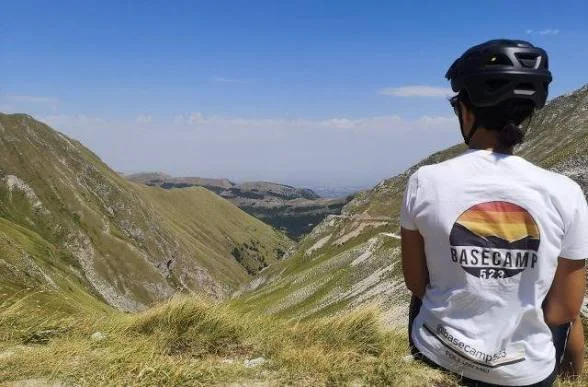
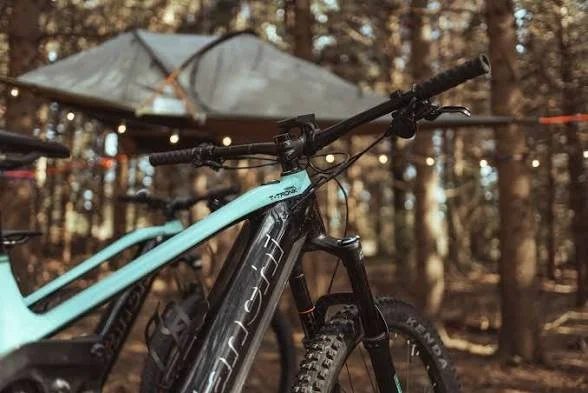
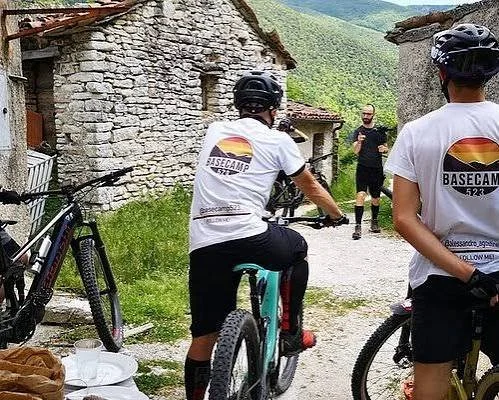
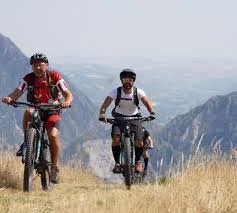
Now they run bike trips through mountains that most people driving past on the autostrada never think to look at. Self-guided tours are still somewhat of a strange concept in Italy, so much so that people assume they're more complicated than they are. He hands over a road book, a map, an app, and takes care of the part that everyone dreads: hauling your own luggage from town to town. He also explained that they've created a tree-tent camp (which started as an earlier glamping idea tied directly to the bikes), which is mobile, dropped wherever the trip calls for it, staffed by two people and a guide, and built to leave no trace.
People who don't know the business, Marco said, tend to think he's "doing something really strange." Self-guided touring still isn't common here, and most people's mental picture of a bike trip is a guided group, not a road book, a map, and the freedom to set your own pace.
When I asked him about the future of his businesses, Marco explained that he's not worried about AI taking his job. "Technology can plot elevation and read a gravel road on a map, but it has no idea how big the stones actually are until a bike wheel is rolling over them," he said. That kind of knowledge only comes from being there, which is maybe the whole point of what he does. He still uses AI and technology to automate what he can, but the parts that matter most stay his. The company started in 2021, which, by his own admission, still makes it small, still means there are no real departments, and still means he does a bit of everything. Growth is messy no matter who you are, he explained to me.
More than anything, what makes the work feel special to him is the people and the fact that it takes him to beautiful places almost every day. Surrounded by beauty, as he put it, is just part of the job description.
Ask him what visitors should actually do here, and he'll tell you the truth first: it can be hard to keep people in Fabriano for more than a day, because it isn't a tourist destination yet. It's usually just one stop folded into a bigger package, and on bike trips he tries to squeeze in whatever activity he can. But if you give him more time, he'll suggest the bike museum built around the jobs a bicycle used to do here: fireman, petrol seller, the small machines of a town's daily life. He'll send you into a paper workshop at the Fabriano Paper and Watermark Museum, where an artisan still makes sheets by hand, because touching history is different from reading about it. He'll mention the historical centre too: an enoteca, the Palazzo del Podestà, a city whose bones date back to the eighth century, and cathedrals in the old town that house works by artists active between the twelfth and sixteenth centuries. If you're up for it, even a small factory nearby turns old clothes, cast-offs from names like Fendi, into paper for gifts, and there's a brewery worth the detour if you have the time.
He also spoke with me about Verdicchio, grown on these same mountains, tasting different depending on which slope it came from, and about the region's claim to the first method ever used to produce sparkling wine, with a museum and vineyards tucked into the hills. And importantly, the thing almost nobody mentions is that if you stand on the eastern edge of town, you can see both Le Marche and Umbria. And, if you keep heading west, the Adriatic shows up on the horizon. Truly the kind of slow tourism that rewards people who linger, down to the old pharmacy in the center of town that's become a small attraction in its own right.
What Marco and Silvia are building next is the harder part: a bar called BC Cafe Fabriano in the main square, which has already become a full-time job. The goal was to embrace a more international environment while featuring local products, serving avocado toast alongside ham from the local butcher, specialty coffee, local beer, and wine, all sourced with an eye toward sustainability. It's meant to be a bridge, a way to translate those values into hospitality and to build a sense of community around the bar itself. As the businesses have grown, Silvia has taken on more of it herself, especially the cafe, which has become as much hers to run as his. A guest house is the logical next step, as Marco explained, something spread through the old town instead of centralized, an albergo diffuso he's been talking through with Sara of Fritto Mistocomune It would be an ethical way of doing accommodation, he says, one that ties all of the experimental pieces of the business together- tours, bar, and beds- into a single, more diversified whole.
The idea underneath all of it is simple even if the execution isn't: give tourists and locals a reason to actually meet. It can be a "narrow-minded province," he explained, and new perspectives, people passing through with different lives and different educations, can open things up here in a way that lasts longer than a single trip. That exchange, locals and tourists able to "melt into one thing" and trade inputs back and forth, is as much the point as any bike route.
He speaks four languages. He still rides. And most days, he says, the job just puts him somewhere beautiful, surrounded by people, which is the whole reason he made the move back.
Through training and a willingness to take a path most people don't, Marco and Silvia have built a business that goes beyond just recreation. Sure, it's a bike trip. But really, it's a chance for outsiders and locals to come together for a few days, then leave the mountains exactly as they found them.
Next time I’m in Fabriano, I know exactly which trip I’d like to do: Sospeso tra Umbria e Marche, the two-day tour that ends with a night in the tree tents. As someone who doesn’t usually bike much, this tour is the perfect mix of easy and short, and includes the tree camp Marco described, the one built to disappear the second you leave. You don't need eight days or expert-level biking skills to get the point of what he's building. Two days on a bike, one night surrounded by trees, and you’ll understand why he came back.
