If you know Fabriano at all, it's probably because of the paper. Odds are, if you went to school in Italy, you've probably owned a sketchbook with the name stamped in blue on the cover and never once wondered where it came from. That's sort of the story of this whole town. Its most famous export, paper, sits in people's hands every day.
I've been in Fabriano this week as a University of Gastronomic Sciences intern with Fritto Misto Comune, working with the founder, Sara, on social media content and journal entries for her two properties and showing the beauty of Fabriano. Researching the town for that work is how I ended up down this rabbit hole, and honestly, it deserves more than the footnote most guidebooks give it. During my time here, I was lucky enough to tour the Fabriano Paper and Watermark Museum (thanks to the Comune di Fabriano!) with the wonderful Jakub, who guided me in both English and Italian.
Although paper is the town's most notable export, it's important to note that it wasn't invented here. It started in Luoyang, China, made out of bamboo, tea leaves, old fabric, boat sails (whatever fiber was around to soak, smash, and scoop into a sheet). In 751, during a military expedition to the Chinese frontier, the governor-general of Baghdad captured two Chinese papermakers in Samarkand. With their help, he established a paper mill in that city, a favourable location because of its abundant water, irrigation canals, and fields of flax and hemp. Thus, the art of papermaking was also learned by the Arabs.
This papermaking process continued along the Silk Road, and papermakers began using vegetable glue to make the sheets withstand water. From there, it moved into Europe through Spain and southern Italy.
That's the main route the craft took to get here. But there's a second, murkier thread too: some local history ties part of the technique to prisoners brought over during the 10th and 11th century conflicts with Arab emirates in Spain and Italy, some held near the port of Ancona before ending up in Fabriano. Two different paths, maybe overlapping. Knowledge around craft moves in strange ways.
Here's the part I especially didn't know before this tour: that vegetable glue that waterproofed the paper didn't work in the European climate. Mould got into the sheets, and the ink bled everywhere. So Fabriano's papermakers, beating pulp along the Giano river with hammers powered by the water itself, ended up switching to animal glue made from skins and bones instead. This small fix made the paper actually usable, and it's why the technique stuck here specifically.
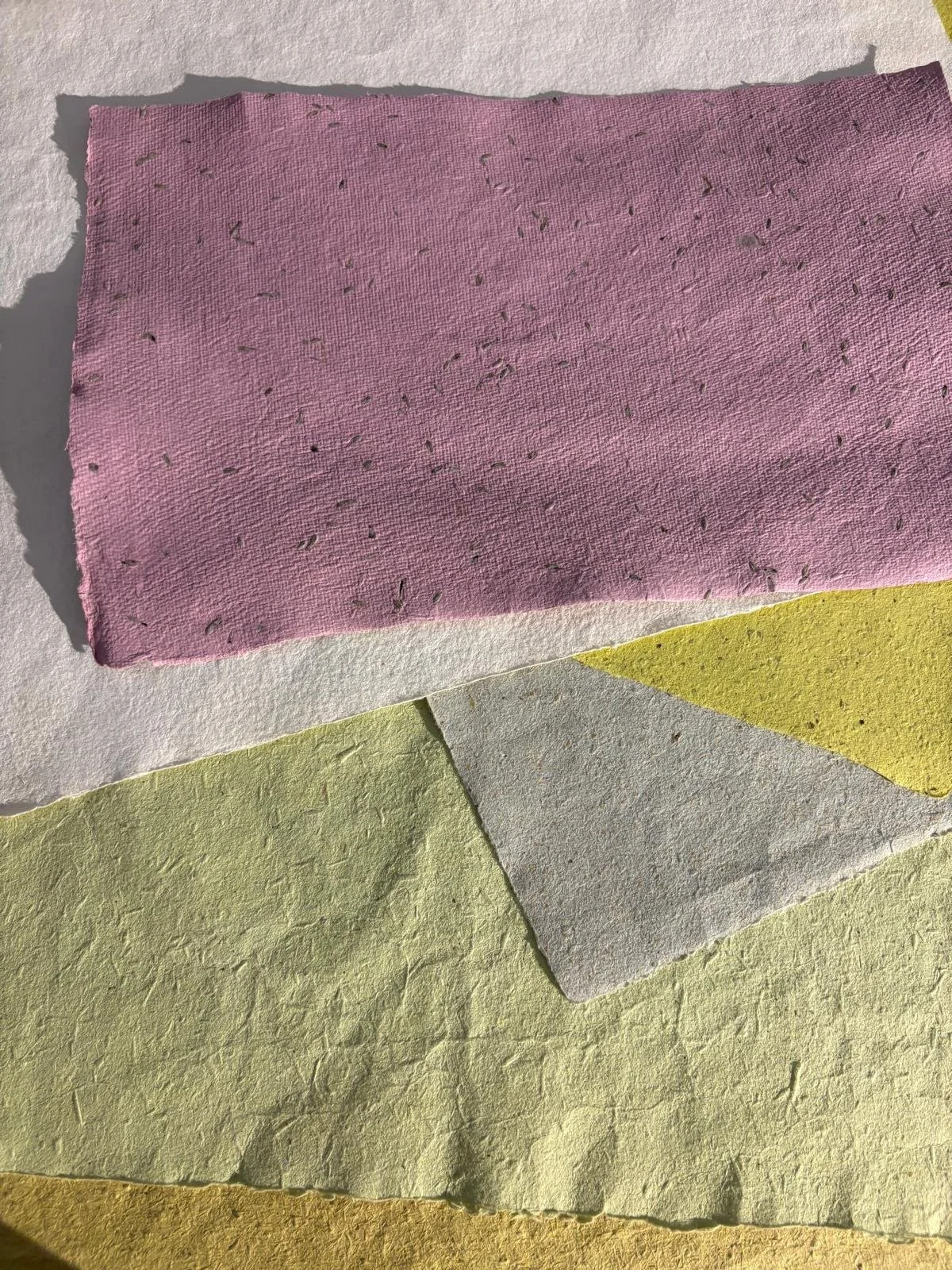
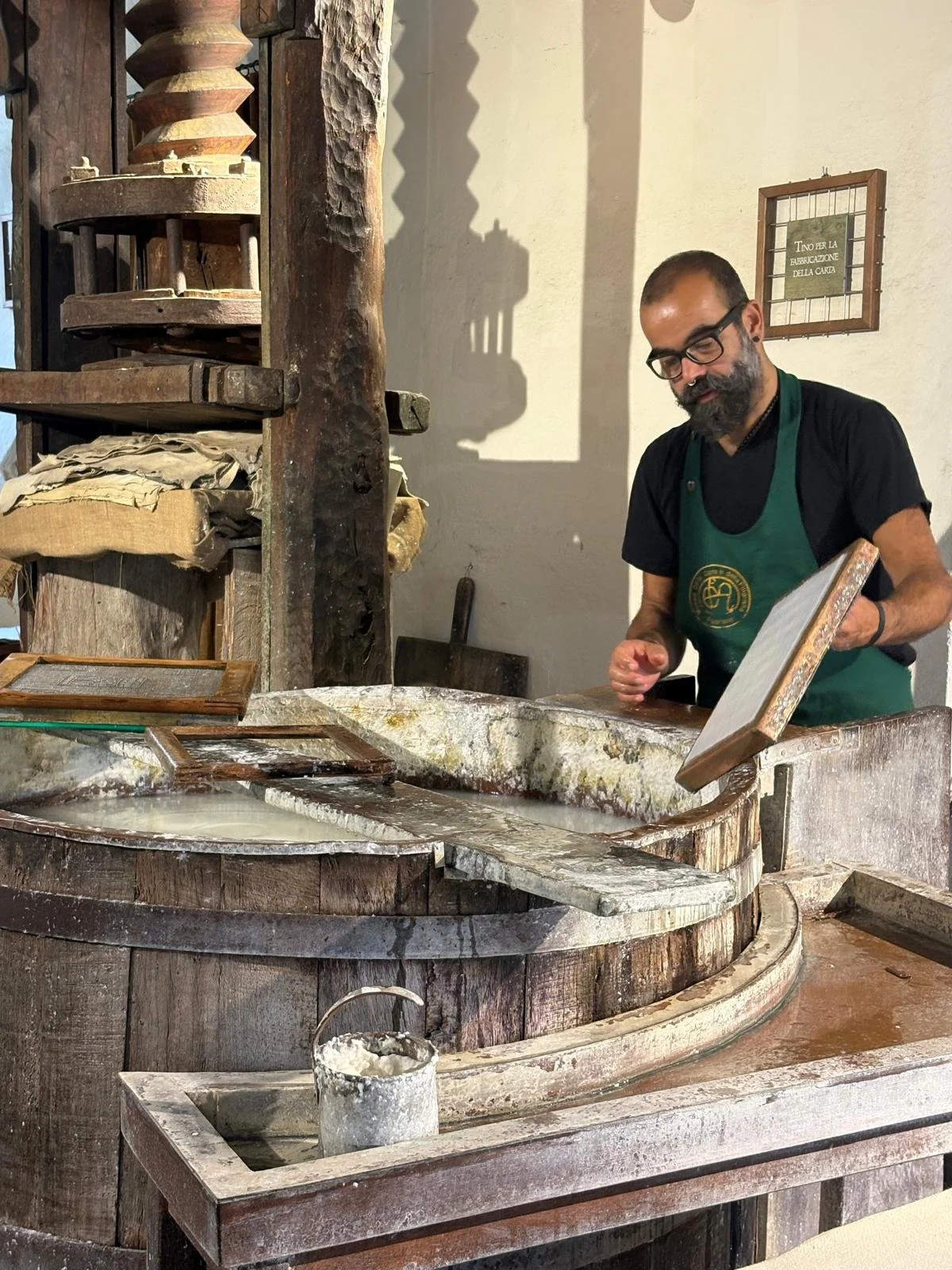
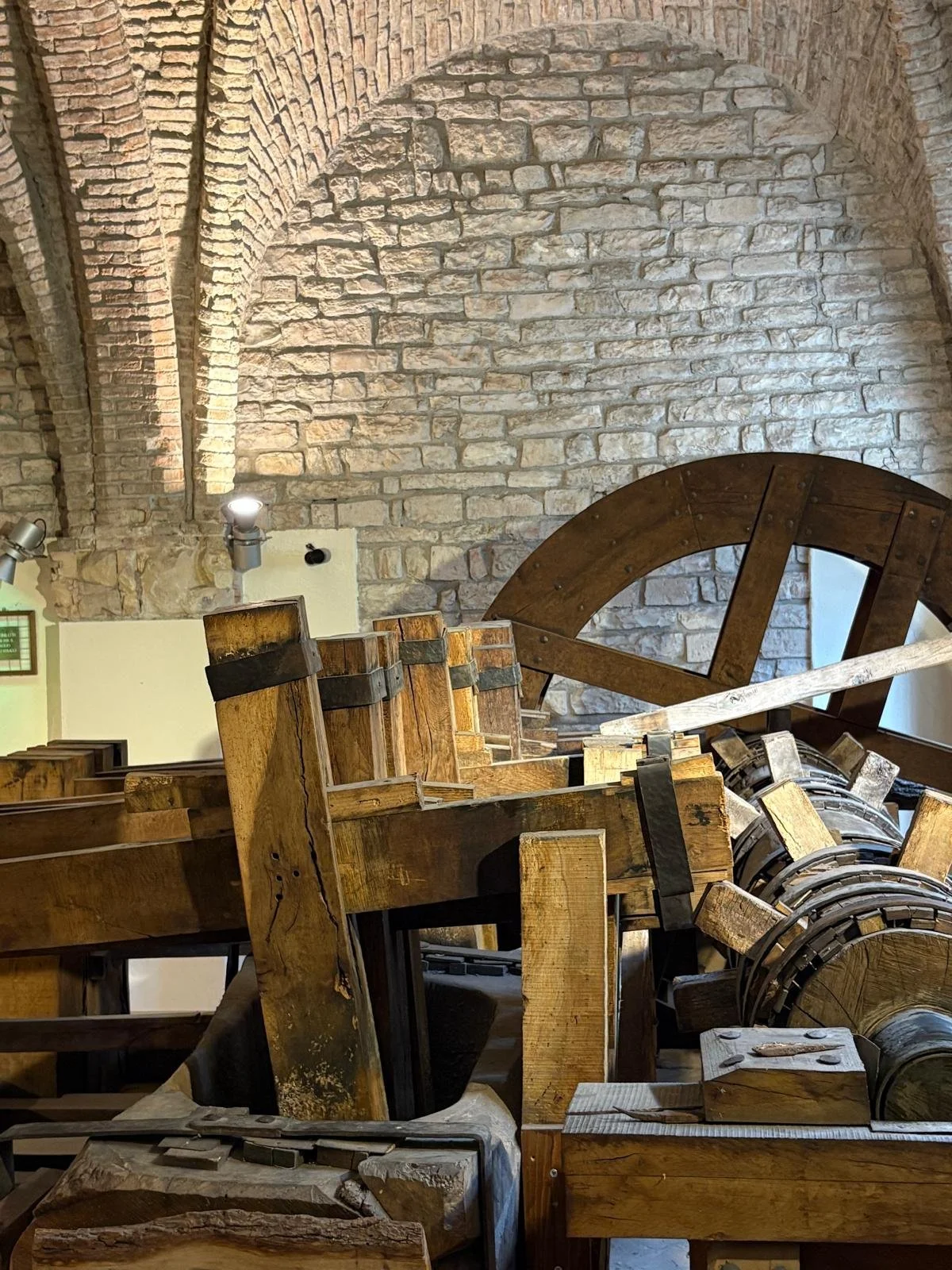
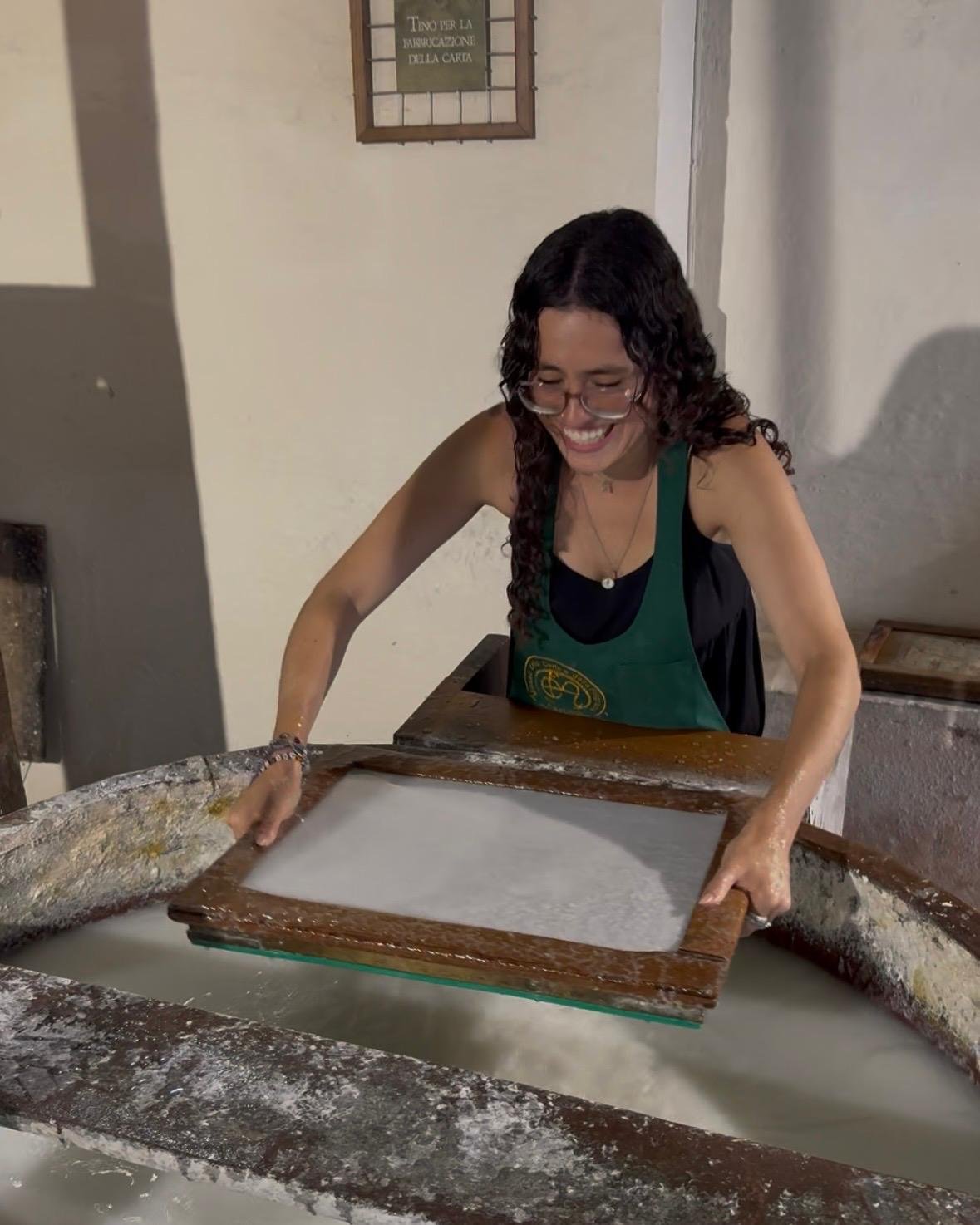
I even got to make a sheet myself during the tour, which changed how I think about all of this. Fabriano is one of the few places in the world where paper is still made by hand, and standing at the tub, you feel exactly why that's such a claim to make. A single tub can produce only about 100 kilograms of paper per day. You immerse a wire screen, the cast form, into the tub of pulp, held inside a wooden frame called a deckle that shapes the sheet. You pull the same amount of pulp across the entire surface each time, gently (very gently!) shaking it to keep it even. Then you move the form to a curved camelback table and rock it in one smooth motion so the paper detaches cleanly from the screen, a step called couching. This process continues sheet after sheet, felt after felt, until the stack goes under a hydraulic press, the original method for pulling water out of paper. Then, the sheets are hung to dry, dipped in that famous animal glue to make them ink-proof, and dried again.
Three things came out of Fabriano in the 12th and 13th centuries that are still part of how paper gets made anywhere: the hydraulic hammer mill with multiple hammers, the watermark (1293, and the early ones even had the maker's last name worked into the design), and that animal glue. This is also the town that printed the first banknote with a watermark.
The Paper and Watermark Museum sits in what used to be a Dominican cloister right by the river, which also tracks, since the river is the whole reason any of this happened here in the first place.
The watermark part is worth a minute on its own, because it's much more involved than I had ever expected. Fabriano's papermakers started countersigning their work with watermarks toward the end of the 1200s, and the ones that survive from the 1400s and 1500s show just how good these mills became at the craft, especially for paper meant to carry real value. You won't see a watermark looking at the page head-on. You have to hold the sheet up to light for the image to appear, since it's really just a difference in paper thickness, thinner where the design presses in, and that's what lets light through unevenly to reveal it.
Making one starts with a punch, a tool pressed into the screen, and the paper is formed onto it to create the image. The earliest punches were carved in relief into hardwood, walnut, cherry, or boxwood, the design raised and the background cut away. Then it was hammered into an annealed bronze sheet until the image transferred over. By the late 1800s, mills had moved to lost-wax casting, carving the design in wax and then casting it in bronze. By the early 1900s, the process shifted yet again to an electrochemical technique, running a wax original through a galvanic bath to produce copper plates that pressed the design onto a metal screen.
All of which is to say, every watermark you've ever held up to a window probably started as a piece of hand-carved wood or wax, right here. Our guide actually pulled out banknotes from a handful of different countries to show us their watermarks, then held them under UV light to show how they show up even more clearly that way. It's a strange thing to realise that Fabriano's oldest trick and currency security basically come from the same idea.
Importantly, Fabriano became a UNESCO Creative City in 2013 in the Crafts and Folk Art category, largely on the strength of its iconic paper-making history. What I like about it is that the designation isn't just sitting on a plaque somewhere. People truly still make the paper by hand here. And it turns out I'm not the only one convinced this town is worth the detour.
If you want more proof that this town is a real destination, look at Ketti Wilhelm, the sustainable travel blogger behind Tilted Map. Not only did she join me on this wonderful tour, but she also did a guided e-bike trip through the region with the local company, Basecamp523, starting right here in Fabriano by Marco, before heading toward the coast. Their tour had stops at artisan workshops and half-abandoned mountain villages along the way.
And, Fabriano is easier to reach than people may assume. Direct trains from Rome take about two to two and a half hours. From Ancona, it's about an hour, and if you're coming from abroad, the airport there is an easy option too. It's the perfect add-on to any Le Marche trip.
Thank you
None of my experience here would have happened without my internship. I'm genuinely so grateful to the Comune di Fabriano and to Sara for the trust this summer, letting me take on the content and work behind Fritto Misto Comune. Getting to actually dig into this town's history instead of just passing through this week has been one of the absolute best parts of my experience here in Italy :)
Eliza Roth